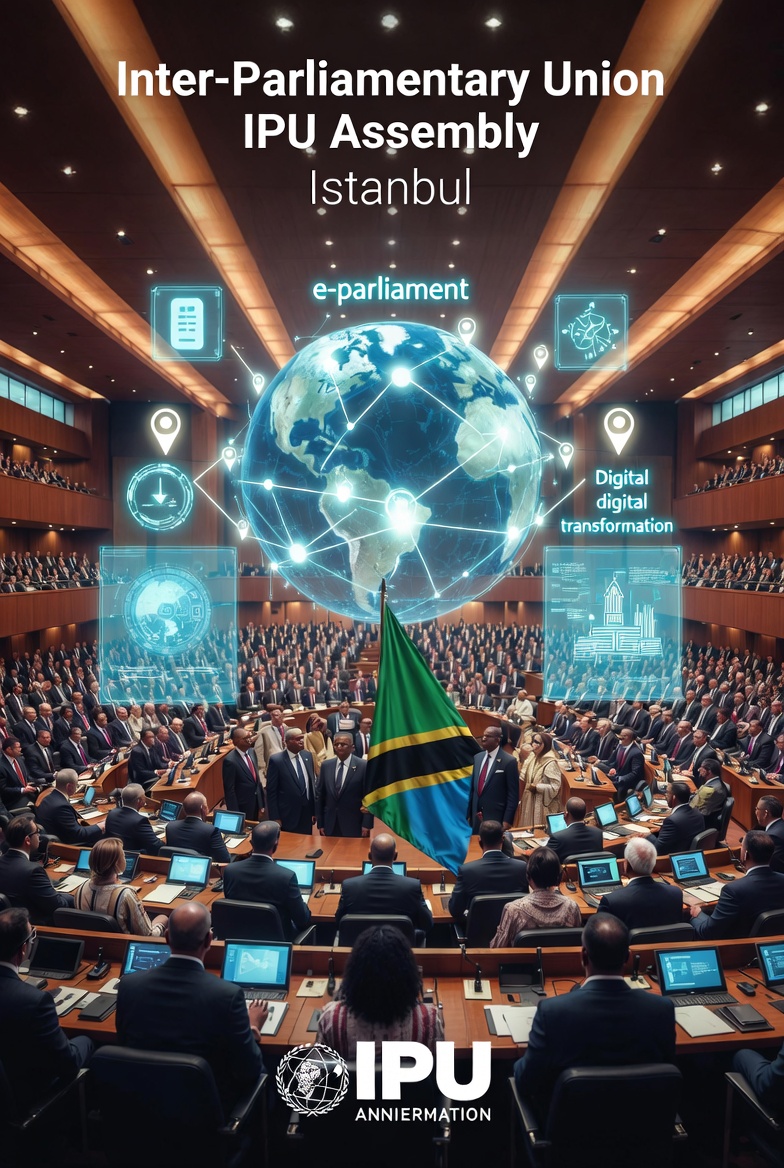
Tanzania is drawing on international experience to refine its parliamentary systems, as lawmakers gather at the Inter-Parliamentary Union (IPU) Assembly in Istanbul, a forum increasingly shaped by questions of democratic resilience and digital transformation.
At the 152nd session of the IPU, which convenes legislators from across the world, Tanzania’s delegation has framed its participation as part of a broader effort to strengthen institutional performance and reconnect legislative work with citizens’ expectations.
Leading the delegation, the National Assembly’s deputy speaker, Daniel Sillo, said the gathering offered more than diplomatic visibility. It was, he suggested, a working platform for benchmarking reforms against global standards.
“Our Parliament is strengthening cooperation with others and learning from global best practices to enhance our capacity to serve the people of Tanzania,” he said, underscoring a reform agenda that leans heavily on institutional learning rather than insularity.
The tone of discussions in Istanbul reflects a wider shift within the IPU itself: away from procedural exchanges and towards more substantive debates about how legislatures can respond to complex, cross-border challenges. Issues such as democratic accountability, conflict prevention and the integration of digital technologies into lawmaking have dominated proceedings.
For Tanzania, the timing is significant. The country is preparing to host the 153rd IPU Assembly in Arusha in October 2026, an event expected to draw more than 2,000 delegates from 183 member parliaments. The Istanbul meeting therefore doubles as both a learning exercise and a diplomatic prelude.
Alongside plenary sessions, Tanzanian representatives have also engaged in more specialised policy discussions. Zeyana Abdallah Hamid participated in a parliamentary network meeting focused on protecting the health of women, children and young people in times of crisis — an area where legislative oversight is often tested by emergencies.
Her intervention reflected a growing consensus that parliaments must play a more assertive role during disasters and conflicts, not only in passing laws but in safeguarding continuity of essential services.
“Parliaments have a critical role in ensuring that reproductive health services, nutrition, immunisation and preventive care for women, children and youth are not disrupted,” she said, pointing to the need for sustained budget commitments and stronger scrutiny of implementation.
The emphasis on health equity aligns with Tanzania’s broader development narrative, which has increasingly foregrounded maternal and child health as a national priority. “No one should be left behind,” she added. “Reproductive health is a right, not a privilege.”
Beyond policy debates, the Assembly has also provided a platform for administrative reform. Parliamentary clerks from member states have exchanged strategies on modernising legislative institutions — an area where Tanzania is seeking to accelerate change.
Representing the country’s parliamentary administration, Daniel Eliufoo outlined ongoing efforts to digitise legislative processes, including the rollout of online parliamentary platforms and e-parliament systems designed to improve transparency and efficiency.
Such initiatives form part of a longer-term push tied to Tanzania’s development ambitions, where institutional credibility and service delivery are increasingly linked to technological capacity.
Yet the Istanbul gathering is not only about governance. It also carries a quieter economic dimension. Tanzania has used the occasion to promote its tourism and investment prospects ahead of the Arusha Assembly, with officials reporting strong interest from delegates.
Vivian Temi of the Tanzania Tourist Board said the country’s exhibition stand had drawn considerable attention, with some participants already confirming attendance for the 2026 event.
The convergence of diplomacy, reform and economic positioning illustrates how multilateral forums such as the IPU are evolving. They are no longer confined to parliamentary dialogue but increasingly function as arenas where governance, development and soft power intersect.
For Tanzania, the immediate gains may lie in technical exchange and institutional learning. But the longer-term test will be whether insights gathered in Istanbul translate into tangible improvements at home — in legislative scrutiny, service delivery and public trust.
As Sillo put it: “A strong Parliament builds a strong nation.”
Ends